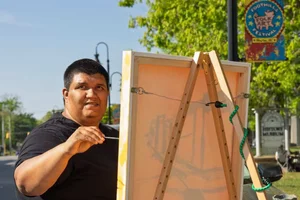
This past weekend, the paintbrushes stayed in the studio and I spent the weekend with family—celebrating birthdays, hanging out with nieces and nephews, catching up with my in-laws, eating way too much good food, and watching everyone enjoy water slides and a dunk tank.
It was exactly what I needed.
Now, before anyone asks…
No, I did not go down the three-story water slide. If you know me, you already know why. They would’ve needed EMS on standby just to get me down that thing. I’ll happily cheer everyone else on from solid ground.
But something else happened this weekend that mattered just as much.
I rested.
Not because I was lazy. Not because I didn’t have work to do. Because I needed it.
If you’ve followed my journey for any length of time, you know I’ve been open about living with PTSD. Sleep isn’t a cure, but it’s one of the best tools I have for keeping the symptoms at bay. When I’m well-rested, I’m better equipped to handle whatever comes my way.
Sometimes the most productive thing you can do isn’t produce.
It’s resting.
It’s laughing with family.
It’s putting the phone down.
It’s making memories with the people you love.
Last week, I finally made it back into the studio, and I can’t even describe how good it felt to paint again. There’s something about putting brush to canvas where everything else fades into the background. It reminds me why I fell in love with art in the first place.
I’ve been working on a brand-new series, and every painting feels like another chapter in a story I’ve been wanting to tell for a long time.
And somewhere in that process, I realized something.
A few weeks ago, I wrote about a question that had been weighing on me:
What kind of artist do I want to be?
I wrestled with labels. I didn’t want to be known as just a landscape painter. I didn’t want to feel boxed into painting one subject because that’s what people expected from me.
I wanted the freedom to paint whatever the hell I wanted.
And I still believe that.
But over the past few weeks, something became incredibly clear.
No matter what I paint…
I always find myself coming back to the West.
Not because someone told me to paint it.
Not because it’s trending.
Not because I think it’ll sell.
Because it’s part of who I am.
I was born in Venezuela, but I grew up in Utah. I had the privilege of having some of the most incredible landscapes imaginable right in my backyard.
State parks.
National parks.
The Wasatch Mountains.
Red rock deserts.
Alpine lakes.
Endless hiking trails.
Antelope Island.
Those places didn’t just shape my childhood.
They shaped the way I see the world.
They taught me to slow down and notice the way light moves across a mountain, how a storm can transform a landscape in minutes, and how much beauty can be found in wide-open spaces.
Even now, living in North Carolina, I still find myself returning to those memories.
When I imagine my next painting, more often than not, it’s the American West staring back at me.
Then Monday happened.
My wife asked if I’d be okay listening to a podcast episode with her. She asked first because we both know that certain things can trigger my PTSD, and she wanted to make sure I was in a place where I could handle it. I honestly thought I would be fine.
I wasn’t.
Something in that episode caught me completely off guard and sent me into a trauma response.
It’s amazing how quickly things can change.
I went from having one of the best weekends I’d had in a long time to feeling like the floor had been pulled out from underneath me.
The best way I can describe the last few days is like a Rolodex of emotions that just wouldn’t stop spinning—anger, frustration, irritability, anxiety, and complete mental exhaustion.
Trauma doesn’t politely knock on the door.
Sometimes it kicks it down when you least expect it.
Normally, I’d head straight to the studio, grab a brush, and work through it.
This time, I couldn’t.
It was simply too much.
When I said I needed rest, I didn’t just mean sleep.
I meant I was exhausted from fighting it.
I was tired of carrying it every single day. Tired of feeling like I was always in survival mode. And if I’m being completely honest, I wasn’t just tired—I was tired of living. That’s how dark things had become.
Not because I wanted to die.
Because I was exhausted from constantly trying to survive.
Trauma has a way of convincing you that you’re trapped in a fight you can never win. Every day felt like another battle, and I didn’t know how much longer I could keep carrying the weight.
Tired of feeling like something outside my control could hijack my week in a matter of seconds.
If you’ve never experienced trauma, it’s hard to explain how something as simple as a conversation, a smell, a sound, or a podcast can instantly pull your brain back to places you’ve worked so hard to leave behind.
The good news is I’m starting to come out of it.
I don’t know if I’ll be back in the studio tomorrow or next week, and that’s okay. I’m learning that healing isn’t pretending I’m fine. It’s giving myself permission to recover instead of beating myself up for not being productive.
And maybe that’s why this realization about the West has been so important.
Because I’ve finally stopped asking permission.
I’ve stopped worrying about whether my work fits neatly into a category.
I’ve stopped wondering whether I should paint something else just because it’s expected.
The truth is, I’ll always chase beautiful light wherever I find it. I’ll still paint a coastal marsh, a woodland trail, or a mountain overlook if it speaks to me.
But I’ve come to accept something I’ve probably known all along.
I can’t be me without the West.
The West isn’t just a subject I paint.
It’s where I learned to see.
It’s fly fishing on quiet rivers.
It’s dusty trails, wildlife, weathered barns, ranches, cowboys, and endless skies.
It’s watching light spill across red rock and mountain peaks.
It’s the place that taught me to slow down, to pay attention, and eventually to become an artist.
Maybe that’s the answer I’ve been looking for all along.
Not:
What kind of artist do I want to be?
But:
What places made me the artist I already am?
For me, the answer has never changed.
The American West.
I share all of this because I never want people to confuse the trigger with the person.
This isn’t who I am.
It’s something I carry.
I’m still the same guy who gets excited about a fresh canvas, loves teaching art, laughs too hard at bad jokes, and somehow believes buying another paintbrush is always a good investment.
PTSD may shape some of my days, but it doesn’t get to define my life.
If you’re carrying your own invisible battles, I hope you know this:
Needing rest doesn’t make you weak.
Healing doesn’t always happen on our timeline.
Sometimes strength looks less like pushing through and more like saying,
“Today, I’m going to be kind to myself.”
I’m incredibly grateful for my family, for a wife who walks beside me even when neither of us sees a trigger coming, and for all of you who continue to support my art and encourage me along the way.
The paintings will still be waiting.
The easel isn’t going anywhere.
And when I pick up that brush again, I’ll do it with the same gratitude that’s been there since I was a kid asking for art supplies instead of toys.
Until then, I’m choosing grace over guilt.
One day at a time.