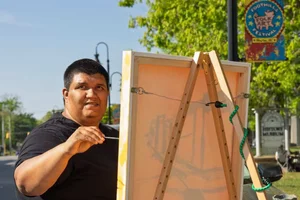
How I Got Started in Plein Air Painting (And My Slight Gear Problem)
Before I get into how I started plein air painting, there’s something you should know about me.
I love travel bags.
Not a casual appreciation. I mean a deep, borderline concerning admiration for them. The compartments, the zippers, the hidden pockets, the clever organization systems. I love it all. If a bag has a place for everything and everything has a place… I’m probably already adding it to the cart.
And most importantly—I refuse to check luggage. Checking a bag costs money, takes time, and there’s always a chance your bag ends up in a completely different city living its best life without you. Carry-on only. Always.
So naturally, this love for organized gear somehow blended perfectly with painting.
About seven years ago I was doing what many artists do late at night—scrolling through YouTube instead of sleeping. By that point I had already made up my mind that I wanted to pursue art full time. I was watching anything and everything related to painting when I stumbled onto the YouTube channel by Michael Chamberlain.
In one of his videos he started talking about his plein air setup—his gear, his pochade box, how everything packed neatly together and how mobile it all was.
And that was it.
I didn’t even finish the video before thinking:
“Yep… I’m doing this.”
Because now we had two things happening at the same time:
Painting outdoors.
Cool gear that packs neatly into organized compartments.
I was SOLD.
So I went and bought my first setup: a Sienna Pochade Box and a basic camera tripod from Amazon. Nothing fancy. Just enough to get started.
I took it outside, set everything up, probably fiddled with it for way too long trying to make it “perfect”… and painted my first plein air piece.
And I’ve been hooked ever since.
There’s something about painting outdoors that just hits differently. The light is changing every few minutes, the wind is doing whatever it wants, strangers walk by and ask what you’re doing, and occasionally you’re fighting bugs, weather, or gravity.
It’s chaotic.
It’s unpredictable.
And it’s awesome.
Now here’s where things start to get a little… questionable. Because just like travel bags, once you start looking into plein air gear you realize there are a lot of options.
Lightweight boxes.
Heavy-duty boxes.
Boxes with compartments.
Boxes for tiny paintings.
Boxes for big paintings.
Next thing you know you’re researching things like “optimal pochade box hinge angles” at midnight.
Let’s just say things escalated. At this point I probably own 10+ pochade boxes.
Yes… ten.
No… I will not be answering further questions about that.
But the funny thing is, I still own that very first Sienna Pochade Box… and I still use it all the time. Now here’s the part I really want people to hear if they’re thinking about getting into plein air painting:
You do NOT need expensive gear to do this.
You don’t need a $500 travel bag to carry your supplies.
You don’t need expensive brushes.
You don’t need the latest gear, the newest setup, or whatever fancy thing artists are posting online.
A regular backpack from Amazon or Walmart works perfectly fine. You can get great brush bundle packs from Amazon or even at Michaels. Honestly, the most expensive thing in your setup will probably be your painting box—and even that can be something simple when you start.
Start small. Save up. Build your kit over time.
The real goal of plein air painting isn’t having the perfect gear—it’s learning.
Paint to study composition.
Paint to understand value.
Paint to experiment with color palettes.
Paint to learn how light actually behaves in the real world.
And here’s another important thing:
Most plein air paintings are not masterpieces.
Some of them are… how do I say this politely… learning experiences.
That’s normal. You’re outside. The light changes every five minutes. Sometimes the wind tries to take your painting home with it. Sometimes a bug lands directly in your fresh paint and becomes part of the composition.
It happens. Mistakes are part of the process.
The real takeaway is simple: have fun and paint for you.